



Oceanography
Machine learning for marine systems, climate signals, ecosystem monitoring, and coastal change.
- Ocean depth monitoring
- Temperature prediction
- Ecosystem health assessment
- Plastic pollution tracking
Scientific machine learning for oceanography and health.
PULSE: Scientific Machine Learning Lab is a research lab in the Department of Scientific Computing at Florida State University, founded in 2022 and led by Principal Investigator Olmo Zavala-Romero.
We tackle relevant problems across the ocean, climate, and human health. We apply AI to improve ocean forecasts, data assimilation, and knowledge discovery, as well as to advance the identification and classification of diseases from medical imaging.
Welcome
The lab works across machine learning, climate-related datasets, and biomedical signals.
Mission
Transform complex environmental and health data into usable scientific insight.
Disciplines
Machine learning for marine systems, climate signals, ecosystem monitoring, and coastal change.
Applied AI for biomedical data, imaging workflows, public health analysis, and personalized care.
Latest publications
A selection of recent publications from the lab. Visit the publications archive for the full list and abstracts.
 Olmo Zavala-Romero Alexandra Bozec Eric P. Chassignet
  Jose Miranda
 Olmo Zavala-Romero Jose Miranda
. Deep learning models have demonstrated remarkable success in fields such as language processing and computer vision, routinely employed for tasks like language translation, image classification, and anomaly detection. Recent advancements in ocean sciences, particularly in data assimilation (DA), suggest that machine learning can emulate dynamical models, replace traditional DA steps to expedite processes, or serve as hybrid surrogate models to enhance forecasts. However, these studies often rely on ocean models of intermediate complexity, which involve significant simplifications that present challenges when transitioning to full-scale operational ocean models. This work explores the application of convolutional neural networks (CNNs) in data assimilation within the context of the HYbrid Coordinate Ocean Model (HYCOM) in the Gulf of Mexico. The CNNs are trained to correct model errors from a 2-year, highresolution (1/25°) HYCOM dataset, assimilated using the Tendral Statistical Interpolation System (T-SIS). The CNNs are trained to replicate the increments generated by the TSIS data assimilation package, aiming to correct model forecasts of sea surface temperature (SST) and sea surface height (SSH). The inputs to the CNNs include real satellite observations of SST from the Group for High Resolution Sea Surface Temperature (GHRSST), along-track altimeter SSH observations (ADT), the model background state (previous forecast), and the innovations (differences between observations and background). We assess the performance of the CNNs across five controlled experiments, designed to provide insights into their application in environments governed by full primitive equations, real observations, and complex topographies. The experiments focus on evaluating (1) the architecture and complexity of the CNNs, (2) the type and quantity of observations, (3) the type and number of assimilated fields, (4) the impact of training window size, and (5) the influence of coastal boundaries. Our findings reveal significant correlations between the chosen training window size – a factor not commonly examined – and the CNNs’ ability to assimilate observations effectively. We also establish a clear link between the CNNs’ architecture and complexity and their overall performance. This research uses artificial intelligence to enhance ocean forecasting in the Gulf of Mexico. By using convolutional neural networks, the study improves predictions of sea temperatures and heights by integrating real satellite data with existing models. Through five comprehensive experiments, the team found that the amount of training data and the design of the neural networks significantly affect accuracy. These insights pave the way for faster, more reliable ocean models, benefiting environmental monitoring and maritime operations. 1
Olmo Zavala-Romero Eric P. Chassignet Philippe Miron Bulusu Subrahmanyam Lagrangian coherent eddies efficiently transport water properties, such as heat and salt, as well as tracers, including oil, larvae, and Sargassum, throughout the ocean. For instance, during the 2010 Deepwater Horizon oil spill, part of the oil was captured within a Loop Current Frontal Eddy (LCFE), preventing it from reaching the Florida Keys. Similarly, Loop Current Eddies (LCEs) carry warmer, saltier waters typical of the Caribbean Sea to the western Gulf of Mexico (GoM). In this study, we employ machine learning alongside various satellite observations—absolute dynamic topography (ADT), sea surface temperature (SST), and chlorophyll‐a (Chl‐a)—to identify Lagrangian coherent eddies in the GoM and predict their lifetime. Three durations of Lagrangian coherence are investigated: 5, 10, and 20 days. This study also investigates the contributions of Chl‐a to identifying and forecasting LCEs' and LCFEs' Lagrangian coherence, aiming to assess the advantages of integrating this data set into data‐assimilative Gulf ocean models, in addition to ADT and SST. The machine learning model trained with ADT successfully identifies and predicts the lifetimes of eddies, achieving accuracy rates of 90% for LCE identification and 93% for lifetime prediction, along with 71% and 61% for LCFEs, respectively. Incorporating SST and Chl‐a enhanced eddy predictions over ADT‐only or ADT and SST combined, in particular LCEs and LCFEs, highlighting the benefits of assimilating Chl‐a into ocean models to improve the representation and the forecast of these eddies. This machine learning framework has the potential to advance predictions of eddy lifetimes and the advection of various tracers. Plain Language Summary Lagrangian coherent eddies are types of vortices in the ocean that trap water in their interior and transport it without exchange with the exterior water. These eddies play a key role in transporting water properties such as heat and salt, as well as tracers such as oil, larvae, and seaweed (e.g., Sargassum) across the ocean. For example, during the 2010 Deepwater Horizon oil spill, a type of eddy called a Loop Current Frontal Eddy (LCFE) trapped some of the oil, keeping it from reaching the Florida Keys. This study uses machine learning and satellite data—sea surface height, sea surface temperature, and chlorophyll concentration—to identify and predict the lifetimes of Lagrangian coherent eddies in the GoM. Three durations of eddy coherence (5, 10, and 20 days) are analyzed. The machine learning model trained with sea surface height successfully identifies and predicts the lifetimes of eddies, achieving accuracy rates of 90% for Loop Current Eddies identification and 93% for lifetime prediction, along with 71% and 61% for LCFEs, respectively. Adding chlorophyll data from satellites improved the predictions compared to using sea surface height and temperature alone. This machine learning framework can advance predictions of eddy lifetimes and tracer transport.
Jose Miranda Olmo Zavala-Romero Luna Hiron Eric P. Chassignet Bulusu Subrahmanyam Thomas Meunier Robert W. Helber Enric Pallas-Sanz Miguel Tenreiro Jose Miranda Olmo Zavala-Romero
Accurate circulation modeling in the Gulf of Mexico (GoM) is hampered by the limited availability of insitu subsurface data, leading to inaccuracies in subsurface representations. These inaccuracies diminish the reliability of ocean models and constrain the duration of dependable forecasts. This study introduces NeSPReSO (Neural Synthetic Profiles from Remote Sensing and Observations), a data-driven method to efficiently and accurately estimate subsurface temperature and salinity profiles using satellite-derived surface data. This provides an alternative to conventional synthetic data generation techniques. Principal Component Analysis (PCA) is applied to extract the main features of temperature and salinity profiles of an Argo dataset. Then, a neural network is trained to predict these principal features using inputs such as time, location, and satellite-derived absolute dynamic topography alongside sea surface temperature and salinity. The model, evaluated using additional Argo profiles and glider data collected in the Gulf of Mexico, over-performs other traditional synthetic data generation methods, such as the Gravest Empirical Modes (GEM), Multiple Linear Regression (MLR) and Improved Synthetic Ocean Profile (ISOP), in terms of root mean square error and bias. Our findings indicate that our method effectively captures the main variations of subsurface fields, and that synthetic profiles generated by the model align well with actual observations, accurately capturing key features such as thermoclines, haloclines, and temperature-salinity structure of the region. This new method will be implemented in GoM data assimilative models and is expected to improve the accuracy of modeled subsurface currents.
Lab news
Announcements, project updates, and behind-the-scenes notes from the team.
announcements
Oct 7, 2026
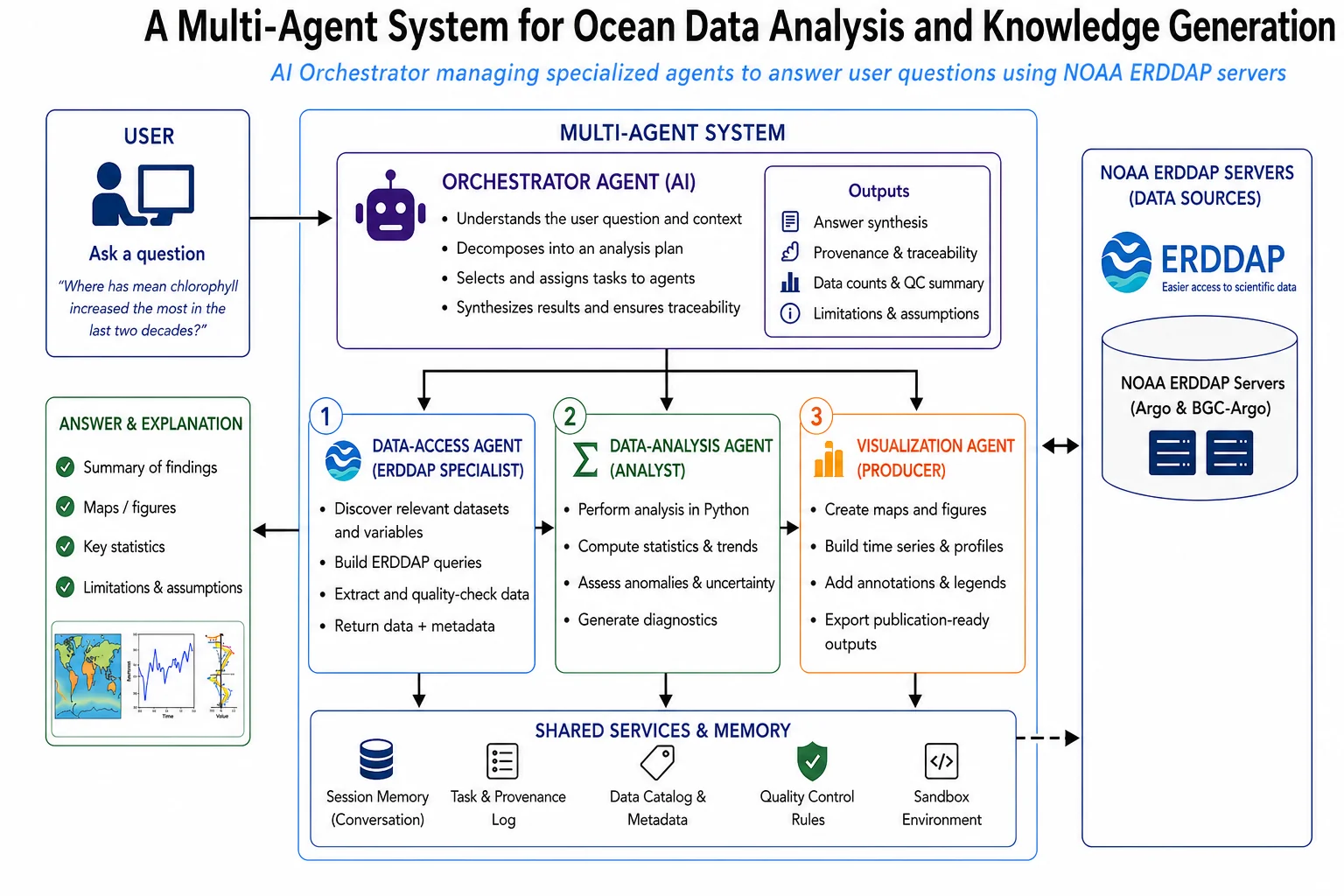
NOAA's Global Ocean Monitoring and Observing Program selected the lab for one of eight FY26 AI and Data Management pilots: a multi-agent AI system that answers plain-language questions about ocean observations with traceable, reproducible results.
announcements
Oct 6, 2026
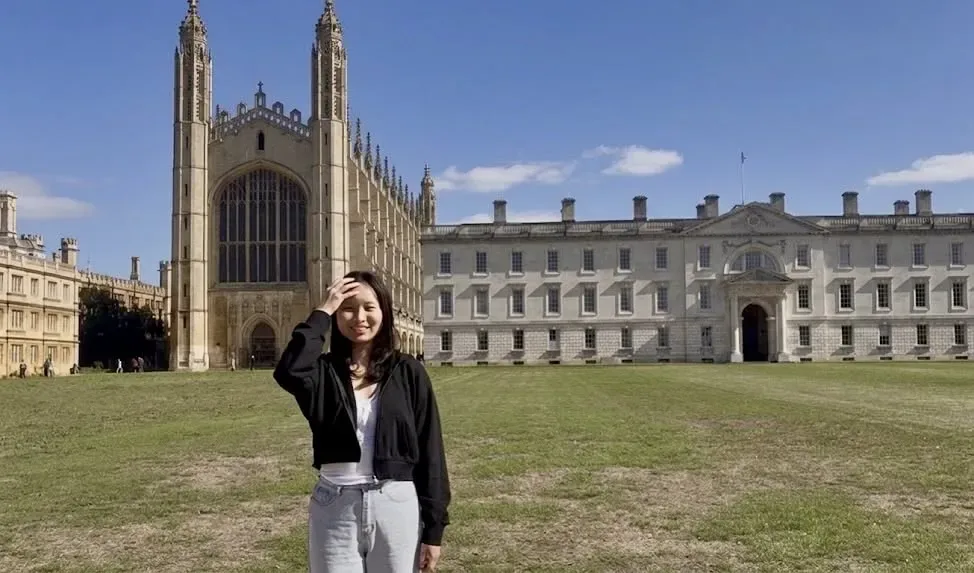
Doctoral student Yifan Wang has returned from two events in Europe: the COGNESTIC 2026 neuroimaging summer school at the University of Cambridge and the MICCAI 2026 conference on medical image computing in Strasbourg, France.
announcements
Jul 1, 2026

The FSU SC Artificial Intelligence Seminar now has a Discord server. The seminar meets Fridays at noon in DSL/SC-499 and on Zoom, with talks spanning scientific machine learning, diffusion models, AI ethics, and human creativity.